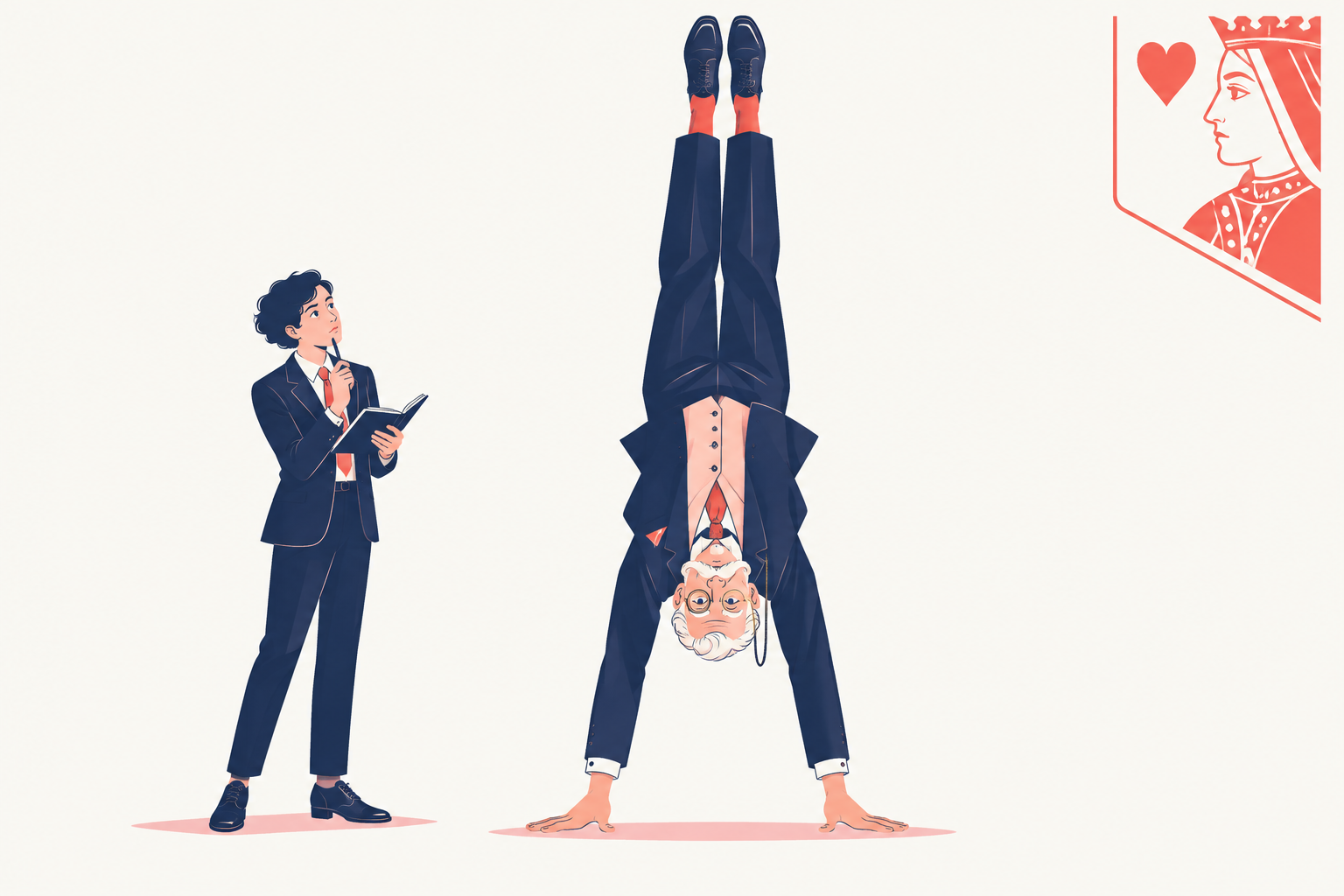
“I am not young enough to know everything.” — Oscar Wilde, The Remarkable Rocket (1888)
Short answer
AI is annexing the repetitive tasks juniors once used to build their mastery, often under real pressure to cut costs and keep a department’s numbers defensible. But decades of research on how workplace expertise and knowledge are built through learning-on-the-job shows that repetitive, deliberate practice is exactly how judgement gets built into the brain in the first place. Bundle that practice into a token subscription, and we are not getting more efficient; paradoxically, we are hollowing out our own future.

AI can be your best friend and yet, in parallel, your worst enemy. That paradox is what I was invited to discuss on 24 September, when Prof. dr. Lou Van Beirendonck asked me to the HR Challenge at Antwerp Management School. I have been quite worried about it for a while, after a huge influx of people writing to me and posting in desperation online, from around the world, about how hard it has been to find work after losing their job, and even more painfully, how hard it has become for today’s starters in the labour market. The question of the debate for the evening: What do starters still mean in tomorrow’s labour market?
Two young women at the debate had both just completed an exclusive and prestigious postgraduate programme at Antwerp Management School, and yet had been searching for their first job for more than a year at the time of the event, until one of them finally signed an offer that very week. The irony is sharp. VDAB’s own figures bear this out: among 2024 school leavers tracked a year later, only 3.1% of higher-education graduates were still job-hunting, against 7.7% for secondary-school leavers, a real advantage, but already up from 2% a few years earlier, and the ground is shifting underneath even that advantage, as Securex figures shared at the debate show under-25s’ share of new permanent contracts falling from 40.3% to 31.8% in a single year, while involuntary dismissals of under-25s on permanent contracts rose from 9.1% to 10.9%, even as the figures held steady for every other age group. Research on candidates with multiple degrees, or a gender breakdown at this level, is rare to find, so I cannot fully disclose those numbers, but what I can plainly say is that an expensive postgraduate year is supposed to shorten a search like this, not leave two of the strongest multilingual candidates in the room still looking after more than twelve months, and I found it quite concerning.
One could see how much it affected them to stand up bravely in front of that audience and speak about their job struggles. Their shame was apparent, though it clearly was not their fault, in my opinion. So me, being a work and organisational psychologist that loves to talk :D, and to boost other people’s confidence, naturally took the microphone to give them some encouragement and kindness: “Do not give up. Keep on being your charming selves. Understand that it isn’t always what it seems, sometimes there are things at play behind the scenes, like a hiring manager who simply cannot train you, or a budget that has changed. It is certainly not your fault that it is taking so long. And if you keep trying, you will succeed.” I meant every word.
Everyone is asking the wrong question
Everyone asks how many jobs AI will remove.
Wrong question! Not even an interesting one, honestly, because of the speed of the market changes.
For someone who has just graduated, the real question is not which jobs will be removed, not when they do not even have a seat at the table to begin with. The question that keeps them up at night is this: which skills will still be relevant to get me a job at all, and keep me in that job, and where exactly am I supposed to learn them if nobody will give me the boring, repetitive job that used to teach it?
Congratulations, you’re the weakest link. And yet, somehow, also a judge?
In the olden days, if you got it wrong, a schoolmaster smacked you on the back of your knuckles, at least in the Anglo-Saxon world, and you knew exactly who had corrected you, and why. The role of the human shifts, without anyone’s notice and without a sticky post-it stuck up somewhere. You no longer produce the answer yourself. You judge somebody else’s: is it right, does it fit this context, and am I willing to put my name under it? Nobody trains you for this job. It just arrives, uninvited and unannounced.
In my view, this takes four things together:
- Domain knowledge, to see when something is wrong.
- AI literacy, to know where AI is strong and where it fails.
- Systems thinking, to see how a workflow fits together and what a change in one place does somewhere else.
- Contextual judgement, to decide when the numbers do not tell the whole story.
What is the catch?
Judgement is built by doing the work yourself. Hundreds of times, with mistakes, with someone looking over your shoulder. That repetitive work is exactly what is now being annexed and handed to AI, not something that silently happened on its own, but a real decision, made under real pressure.
It is very difficult for one to judge well on a topic, that one has never had the chance to learn exactly how to do it for themselves, because judgement is built on exactly that kind of practice, namely via deliberate practice. Certain researchers have proposed to call this absence of opportunity to develop “never-skilling.”
I have thought deeply about this concept called “never-skilling,” and in fact I do not believe it is quite so severe, though it is still concerning: the skill needed to judge simply never got the chance to be created. However, I still believe that one can in fact form an opinion in a field despite having no prior knowledge or skillset, and I do believe that one can always learn to do something one has never done before.
So the question is not only who still learns the trade. It is where the practice ground still exists.
Which skills are most at risk?
A 2026 study by Boston Consulting Group, based on seventy C-suite leaders and senior executives, names the skills most at risk when AI is in the loop: judgement and decision making, problem understanding and framing, creative thinking, analysis and causal reasoning, and solution generation and evaluation (BCG, June 2026).
This is not a random list. These are the skills a job needs room to practise, and a job that careless redesign has stripped down to a fragment has no room left for them.
What does it take to keep the practice ground?
Design, not good intentions. According to the same BCG report, Shell redesigned its junior learning paths: juniors first frame the problem themselves, test their assumptions and produce a baseline analysis, and only then use AI to refine it. The early results BCG reports: better questions, clearer reasoning behind decisions and faster progress towards independent work.
That is not a coincidence. It is work that has been arranged deliberately so that the practice remains.
The usual shortcut, and the opposite move
The common response to this pressure already has a name. Two senior Microsoft engineering leaders, Mark Russinovich and Scott Hanselman, call it an “AI boost” for people who already have judgement, and an “AI drag” on juniors who do not yet have it to steer or check what AI produces. The easy fix is to hire seniors and automate juniors. It removes the first rung, without anyone’s notice, the very rung that every senior role was eventually built on. PwC’s 2026 Global AI Jobs Barometer shows this already happening: entry-level roles in the most AI-exposed jobs are being “seniorised”, increasingly asking for the judgement that used to belong to experienced staff only, a shift up 35 percent since 2019.
That is not a side effect worth noting from the sidelines. It is proof that losing the practice ground is not an accident, it is a shortcut taken on repeat, because nobody has yet handed organisations a defensible alternative.
An idea I raised at the table
Everything above is what the big reports already say. Here is the one thing I have not seen anyone else propose. During the evening, a recruiter from a prominent selection agency told me she is flooded with applications written with AI and cannot answer them all. The two young women in the room had their own side of that same story: they get ghosted, and they never even see or speak to a real recruiter. Looking for work is becoming dehumanising when the first voice you meet is an AI recruiter, while the real recruiters are drowning in applications that have themselves been tailored by AI to beat the system. Jobseekers using AI to get past the recruiter’s AI, and recruiters too buried under the result to reach the humans on either side of it: real star-crossed lovers in a recruitment world, the world on its head again. I told her there is a solution: hire more recruiters from the group of people who are looking for work themselves. Put them in that chair as junior assistant recruiters, and train them to recruit humanely, not just to process a queue, so that other jobseekers have at least a chance of being seen, and truly met, by a human.
Is that not exactly the paradox? The people the system overlooks may be the solution.
That is the opposite move to “hire seniors, automate juniors”. Instead of removing the entry rung, you staff it with the people the AI-flooded system is currently squeezing out. Bank of America has made a version of this choice at much larger scale: it held its 2026 intern class at roughly 4,000 rather than cutting it, and redesigned entry-level work around AI instead of letting AI replace it.
Three questions for every organisation
- Which skills will this work need in three years, and which of them do we already have today?
- Where do people learn those skills now, and does that practice ground disappear if we automate this work?
- Who looks over a starter’s shoulder when they make a judgement, and how do we teach them to do the same?

“In my youth,” said his father, “I took to the law, / And argued each case with my wife; / And the muscular strength which it gave to my jaw, / Has lasted the rest of my life.” — Lewis Carroll, You Are Old, Father William, in Alice’s Adventures in Wonderland (1865)
I consider myself lucky, because since AI entered my world in 2022, I have been thinking about what I can do myself as a work and organisational psychologist. Why? Because I see things that others don’t, quite frankly. And if I have vision, I feel it my responsibility to help in any way possible to alleviate potential suffering at work.
My answer is not a patch on top of the problem. It is mental plasticity: building the capacity in people and teams to keep adapting their own skillset as the work itself shifts, instead of training once and hoping it holds. This was once a question asked of me during my own apprenticeship, to find out if this capability was even possible. My answer then, as well as now, still stands: yes, this future of work IS possible. You just have to WANT to change it, like I do, to create a better future for the generations who come after us.
Though of course, anyone who knows me personally knows that on my birthday, I turn eternally seventeen!
With WorkDesAIgn, I help organisations embed AI without losing the entry-level roles on which starters learn, built on exactly that plasticity.
Thank you to Lou and to Antwerp Management School for a debate with genuine disagreement.
“In fact, you are the STRONGEST link so you may go now: GOODBYE!”
Would you like to know which skills your organisation will need, and where people can still build them?
Get in touch